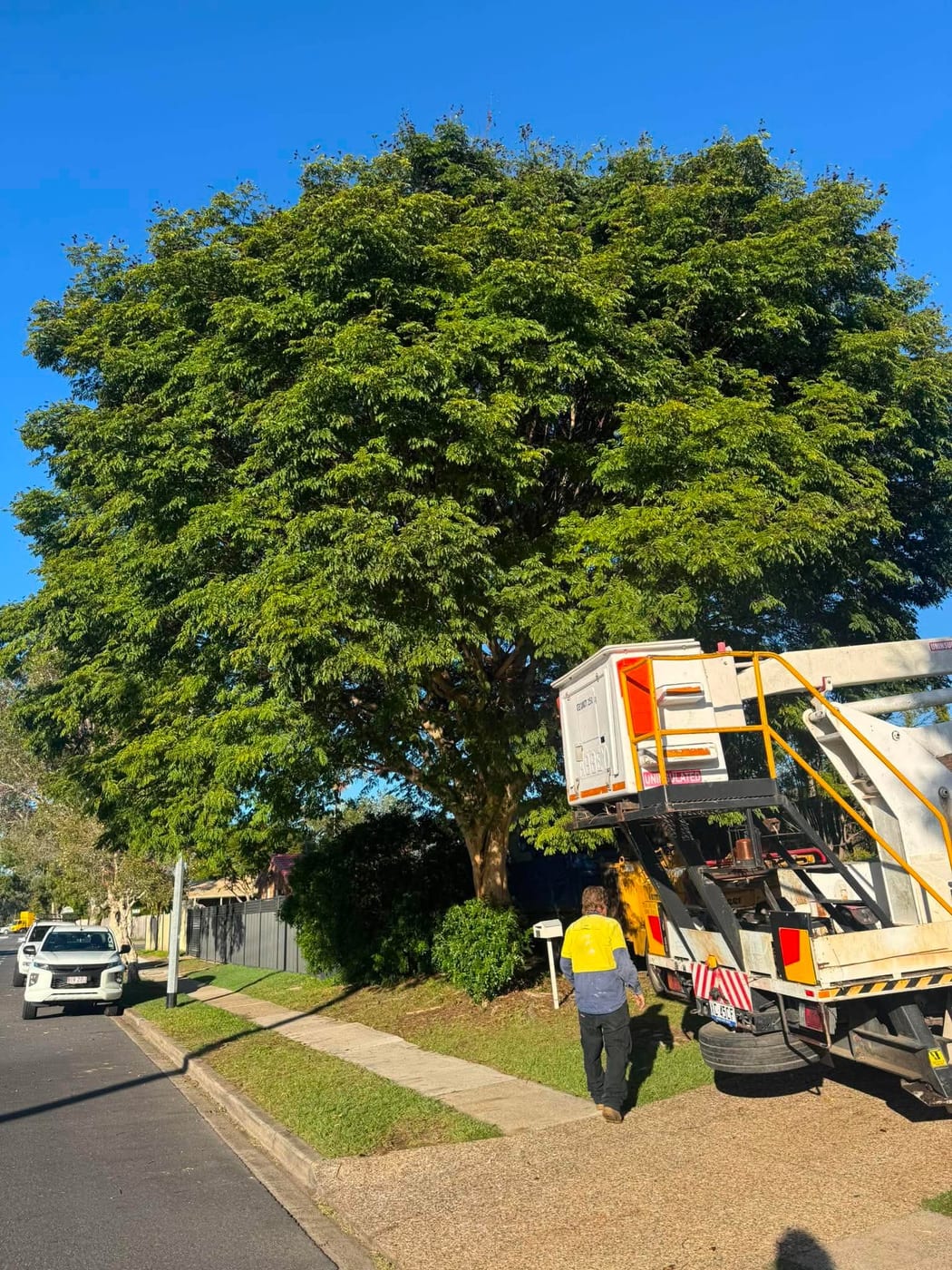
Drive around the Northside after a rough summer and you'll spot it. A big old gum or poinciana that's had its whole top sawn off flat, leaving a row of fat stubs. Six months later that same tree is covered in a thick brush of skinny new shoots, all sprouting from the cut ends. It looks busy and green, so people assume it worked. It didn't. That's lopping, and the tree is now in worse shape than before anyone touched it.
Here's the thing though. Half the people who ring us asking for "tree lopping" don't actually want their tree topped. They want it made smaller, or safer, or pulled back off the roof. "Lopping" is just the word most of us grew up using. So this isn't about correcting anyone. It's about explaining what the cuts actually do, so you know what you're paying for.
What lopping actually is
Lopping, or topping, means cutting branches back to a stub with no thought for where the next growth will come from. The saw goes through the main stems at whatever height suits, often halfway along a branch where there's no side limb to take over. It's quick and it's cheap, which is exactly why some operators still do it.
The problem is what happens next. A topped tree responds by panicking. It throws out a dense cluster of fast shoots, called water sprouts or epicormic growth, right below each cut. Those shoots only attach to the outer layers of the old wood, so they're weakly joined. Within a few years they're heavy, and the first decent storm snaps them clean off. The tree ends up taller and more dangerous than it ever was.
On top of that, a big flat cut through a main stem leaves a wound the tree struggles to seal. Rot, fungal decay and borers get in through the open face and work their way down into the trunk. You often can't see it from the ground. The tree looks alive and leafy while it quietly hollows out.
What proper pruning looks like
Good pruning follows the Australian Standard AS 4373, Pruning of Amenity Trees. It's the rulebook qualified arborists work to. The core idea is simple. Make the smallest cuts needed to do the job, cut in the right place so the wound can seal, and never take more of the canopy than the tree can carry.
The standard covers a handful of jobs, each with a proper name and a proper method:
- Crown thinning. Selectively taking out some inner branches to let wind and light pass through, without changing the tree's overall shape or size. Worth doing before storm season because it lowers wind resistance.
- Crown lifting. Removing the lowest branches to give clearance over a driveway, fence or footpath.
- Crown reduction. Making the canopy smaller by cutting each branch back to a healthy side limb that takes over as the new growing tip. Done right, the tree keeps its natural shape, just smaller.
- Deadwooding. Taking out the dead and dying branches that drop without warning.
The difference between crown reduction and topping is the whole point. Reduction cuts go back to a living branch big enough to keep growing in that direction. The tree heals neatly and the regrowth is strong. Topping cuts go to a stub with nothing below them, and you get the weak sprouts and the rot. A good arborist generally won't take more than about a quarter of the live canopy in one go, because past that you're robbing the tree of the leaves it needs to feed itself.
When reduction or thinning is the right call
Plenty of Brisbane trees genuinely need work. A jacaranda hanging over the roofline, a leopard tree shedding limbs over the kids' trampoline, a camphor laurel blocking every bit of light from the back deck. Crown reduction brings the size down properly. Thinning opens it up so a gale blows through it rather than against it. If a tree is structurally sound, these are far better outcomes than removal, and they last.
Timing matters here too. Brisbane's storm season runs roughly November through March, and our worst call-outs land right in the middle of it. The sensible window to prepare is late winter into early spring, say July to September, so deadwood and weak limbs are gone before the first southerly buster rolls in.
A quick word on council rules
Before any major work, it's worth knowing your tree might be protected. Brisbane City Council protects a lot of vegetation under its Natural Assets Local Law and the City Plan 2014 overlays, and that can apply even to a tree in your own backyard. You can check your address on Council's online property search under the vegetation layer. Permits are free, but the fines for clearing a protected tree without one are not. Dead trees and genuine immediate hazards are usually exempt, though you'll often need photos or an arborist's report to back it up. We sort this out as part of the job.
What to ask a tree company
You don't need to be an expert. A few straight questions tell you most of what you need to know:
- Do you prune to AS 4373?
- Are you fully insured, and can I see the certificate?
- Where will you make the cuts, and roughly how much of the canopy are you taking?
- Is my tree protected, and will you handle the council side?
If someone offers to "top it right back" for a suspiciously low price and can't answer those, that's your answer. The cheap cut today is the expensive, dangerous tree in five years.
If you've got a tree you're not sure about, give Ozzy's a call on 0451 308 349. Happy to take a look, give you honest advice and a free quote, no pressure either way.
Want a hand from a local crew?
We give free, no-obligation quotes across Brisbane's Northside, and we're happy to take a look before you decide anything.